Understanding Piano Fingering and the Mistakes That Catch Out Beginners
Reading Notes First, Finger Numbers Second
In the early beginner stages of learning to play the piano, when it comes to piano fingering there are a few important things to understand.
The first is to always try to read the notes and not the finger number alone. Of course, at the very beginning, as long as you start in the right position, you can somewhat rely on the fingering to locate the right notes for you.
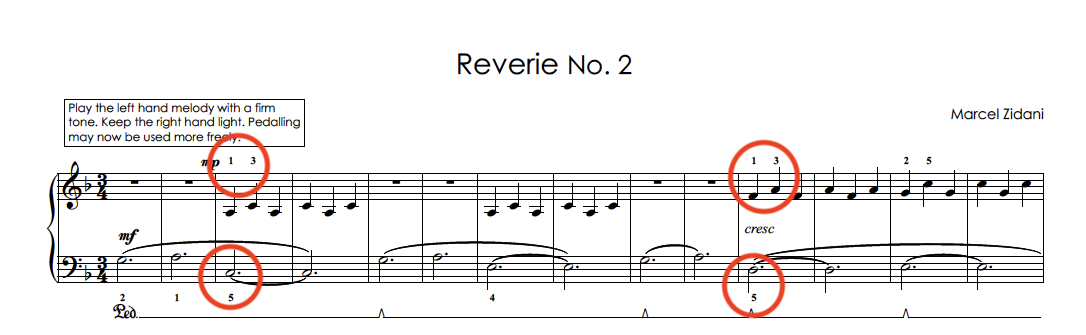
For example, in Reverie No. 2, beginning with the right-hand thumb (1) on A, all you need to do is alternate fingers 1 and 3 without reading the notes. Playing like this without fully reading the notes can actually make the note-learning process take longer whilst providing a short-term fix.
However, as you progress, music becomes a little more interesting and begins to move away from a simple five-finger position.
At the beginning of Reverie No. 2, the left hand begins with the suggested fingering 2, 1, 5. I've taught this piece many times at around the 3-12 month stage of learning for adult beginners. (Yes, there can be a very big difference in learning speeds.)
So often, students will place finger 5 exactly where it sits above in a five-finger position, which would put it on D. Of course, that is the wrong note. Interestingly, later in the music, this is exactly what happens at the end of the line in bars 9-11.
This proves the importance of reading the note and not just the number. See the fingering as a potential warning that a position change is approaching.
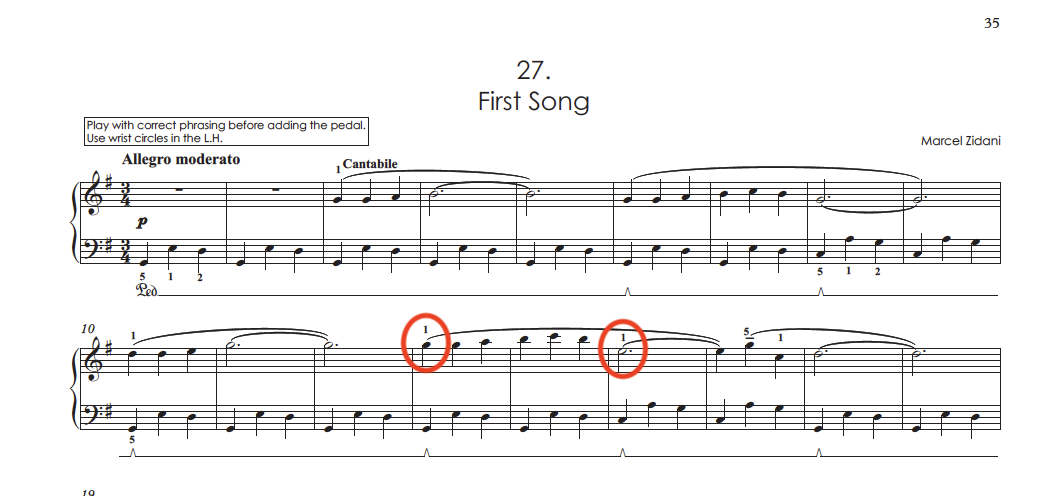
Take First Song as another example. At bar 13, you need to move position completely and play finger 1 on G. Then, 2 bars later, there is another instruction to move position. If you simply place finger 1 down without reading the note carefully, you may well find yourself over the wrong key.
Alternative Fingering vs Bad Fingering
There is good fingering, good alternative fingering, and bad fingering.
For example, in First Song, the suggested fingering at bar 13 is perfectly sensible. For someone who has been learning the piano for around a year, putting finger 1 here makes good sense.
However, finger 2 may be an even better option, leading to a smaller stretch down to the E with finger 1. This is a good alternative. Spending time exploring alternative fingerings, particularly if you struggle with reach or find passages awkward, can be a useful strategy.
That said, as a learner reasonably new to the piano, it is also possible to create problems by inventing your own fingering.
A few things to consider:
-
Your fingering should not break slurs, phrasing, or other articulation that disrupts the melodic line. Otherwise, you are not conveying the composer's intentions.
-
It should not create awkward movements in the arm, wrist, or hand that make the music harder to play.
-
If the original fingering is clearly the better solution, it should be practised until the pattern becomes familiar. One of the advantages of good fingering is that similar patterns often appear elsewhere in the repertoire.
-
By all means, experiment with alternatives, but be open to the possibility that your choice may be causing hesitation, instability, or the musical problems mentioned above.
Changing Fingers on a Repeated Note
Changing fingers on a repeated note can be extremely useful. It often gives a greater feeling of security, control, and consistency of touch.
However, there are also many occasions where editions suggest changing fingers on repeated notes when it is not really necessary.
In Endless Journey from the Hey Presto! Piano Method, there are two almost identical passages. In the first, I suggest changing fingers on the repeated crotchet (quarter-note) notes. In the second, I suggest using the same finger.
The reason is simple. It allows the player to experience both approaches and become comfortable with changing fingers on the same note, which is a technique that becomes increasingly useful as your playing develops.
Once practised, changing fingers on repeated notes often feels surprisingly natural.
Where there are rapid repeated notes, however, there is usually little alternative but to change fingers. This is more advanced territory and not something we'll explore in detail here, but it forms an important part of piano technique in the music of composers such as Chopin, Liszt and Ravel.
Final Thoughts
One of the things I've noticed over the years is that fingering is often treated as an afterthought. Students are keen to learn the notes, the rhythm and perhaps the pedal, whilst the fingering receives only a passing glance.
Yet good fingering quietly solves problems before they appear. It helps the hand move efficiently, supports musical phrasing, and often makes difficult passages feel surprisingly manageable.
The next time you see a finger number written in the score, don't simply ask, "Which finger should I use?"
Instead ask, "Why has the editor or teacher suggested this fingering?"
Very often, the answer reveals something important about the music itself.
About the Music Mentioned in This Article
Reverie No. 2, First Song and Endless Journey are all taken from the Hey Presto! Piano Method and the Adult Piano Beginners Course. These pieces are taught step-by-step within the course, alongside technique, scales, sight-reading and musical interpretation, with regular live group sessions where members can ask questions and receive guidance.
The Adult Piano Beginners Course is designed specifically for adult learners and returning pianists, with over 65 video lessons, personal support, and pathways through to Grade 3 and beyond. The course and Hey Presto! method have also been recommended by Pianist magazine as resources for adult learners.
Course: www.adultpianobeginners.com
Book: https://a.co/d/dh2bKMb
Adult Piano Beginners Facebook Community: https://www.facebook.com/groups/1114361552240767
Marcel Zidani
Concert Pianist, Composer and Piano Teacher
Founder of the Adult Piano Beginners Community and Author of the Hey Presto! Piano Method Series
www.marcelzidani.co.uk
Author
